
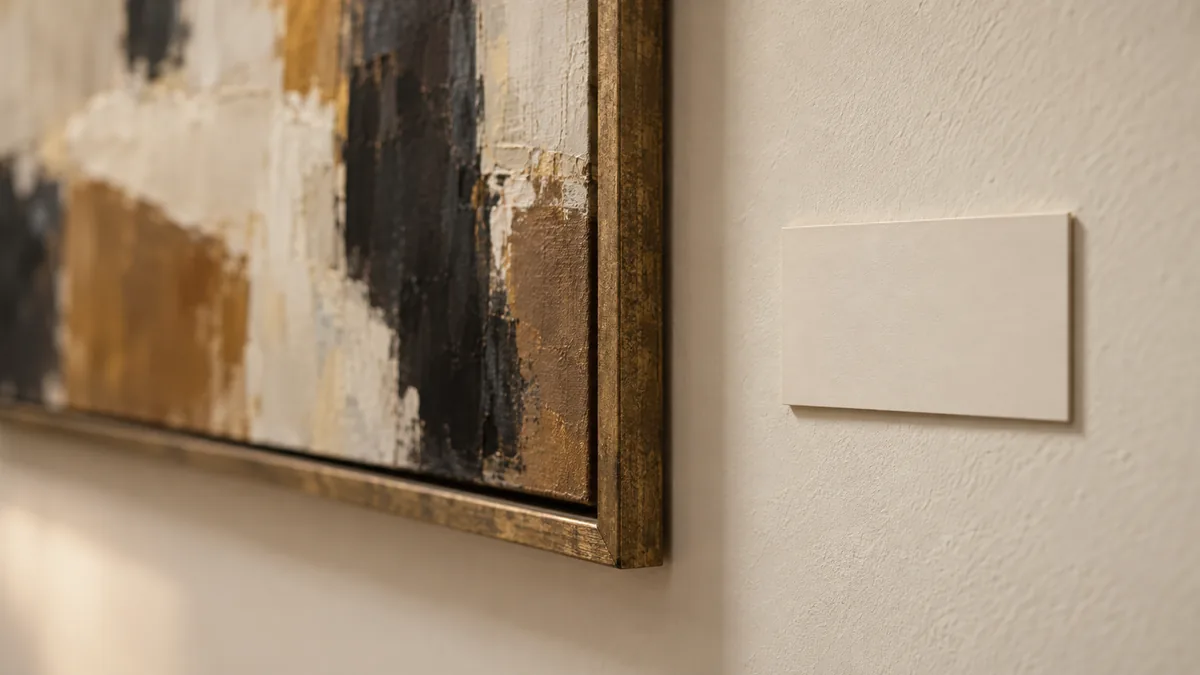
All visitors to galleries read the title before they view the painting. This occurs rapidly – in fewer than two seconds; a glance to the bottom right of the image, and by the time the viewer’s eye returns to the painting, it will be holding a word, a phrase, possibly a date or location. That word accomplishes something. Most often it is not neutral. Titles represent pieces of the architectural structure of the painting, arriving through language instead of paint, and shape what we notice prior to our awareness of having been shaped.
Compare a canvas labeled Grief and a canvas labeled Untitled (Blue), as the former tells the viewer what they should feel before they have experienced anything. The latter withholds that instruction and prompts the viewer to create their own interpretation of the blue, the heaviness of the brushwork, and the particular emptiness of the composition. There are no incorrect methods of viewing a painting. However, each method produces fundamentally different viewers. One visits a painting while primed to find sorrow in it. The other visitor visits a painting using only their own vision, and whatever they identify as they explore the space belongs to them exclusively.
This was not always a pertinent issue. Across numerous art traditions over several hundred years, paintings existed within systems that provided instruction rather than descriptive information. Indian miniature painting traditions used a painting’s title to identify the raga that it depicted, a season, or a pivotal moment from a devotional narrative that the intended audience was expected to understand. The intention behind providing a title was not to provide surprise. Rather, it served as an aid to position the viewer in a shared reference system allowing their focus to shift away from plot and concentrate on nuances and how the painter rendered a previously understood moment of desire or arrival. Thus, in this context, the role of naming was an act of hospitality rather than limitation. It allowed a prepared viewer to access a collective understanding of the subject matter.
The emergence of untitled paintings, particularly in mid-20th Century America, was in large part an indirect reaction to instruction-based labeling. Rothko refused to assign titles to his color-field paintings late in his career due to the same reasons he avoided providing explanations for them during interviews. He wished to maintain the purity of the encounter between the viewer and the artwork, allowing the viewer experiencing one of his paintings to experience the colors directly as opposed to filtering those colors through a word assigned by him to facilitate their comprehension. In this respect abstraction represented both a stylistic divergence from representation, and a disavowal of authorial control inherent in title selection, an effort to return the entirety of the interpretive process back to the individual physically present in the space.
There exists an important concept developed by literary theorists that may be applied usefully to our discussion. Though we apply it cautiously, Gerard Genette referred to that threshold material surrounding texts, such as titles, introductions, cover images, as paratext. These elements functionally determine how a reader initially approaches the text prior to engaging with even a single line of content. Similarly, a painting’s title functions as a type of paratext. It is not the work itself, yet it represents the primary portal through which most viewers first enter. Doorways tend to establish the perspective from which a room is viewed upon initial entry.
When considering how a room presents differently based upon whether a viewer views a title prior to entering that space or after standing before a canvas, we observe significantly differing viewer experiences. Collectors that review titles prior to standing before a canvas generally proceed toward an image seeking verification of their previous feelings regarding the object described in the title, reviewing whether their expectation aligns with their actual experience. Collectors who are instructed to view a canvas first, and subsequently review the title, tend to view an image with greater freedom from prior expectations, and frequently discover that the title reflects or contradicts their existing impression. In certain areas of our space we have begun placing labels somewhat farther from images, neither for aesthetic nor sentimental purposes, but merely because delaying their presentation by even a few milliseconds alters the nature of that first interaction.
Titles placed with excessive emphasis can effectively exclude substantial amounts of potential discovery. When an artist provides an image with too much confidence in its ability to evoke emotion, such as Loss, Homecoming, or Reverie, it may inhibit a viewer from developing their own unique word for describing what they feel, replacing their laborious process of paying attention with the artist’s preconceived notion. While this is certainly not insignificant, as much of what we write about elsewhere concerns ethics related to perception, the amount of patience required to spend sufficient time with an ambiguous image ultimately rests upon viewers’ ability to permit themselves to not yet know what they believe. Titles that appear prematurely confident may unwittingly terminate that permission prior to affording viewers sufficient opportunity to develop it.
Conversely, titles can be acts of beneficence as opposed to restrictive when employed judiciously. Titles offered as destinations, locations, hours of day or night, segments of larger ideas give viewers something to grasp, yet refrain from informing them as to what emotions they should associate with these elements. An image entitled Mylapore, Early Evening does not inform the viewer emotionally like Grief does, but merely situates the image temporally and geographically, thereby liberating the viewer to contribute their own emotional experience associated with this time/place. We find that collectors often react positively to titles situated in this manner, offering sufficient specificity to demonstrate consideration, yet remaining sufficiently open-ended to elicit active participation from the viewer.
Certain artists deliberately deny creating hierarchies within bodies of work by assigning numbers instead of titles, such as Study I through Study IX. Such designation denies suggestion that one image in such a body of work possesses greater significance than others solely based upon receiving a more evocative title. When collecting within a series, which is something worth noting, numbered works are not inherently inferior works. Rather, they often represent a conscious decision by the artist not to employ language as a means of ranking what should be collectively interpreted as variations on a unified investigative process.
It is also worth acknowledging an economic component to titles that merits direct acknowledgment since we are engaged in selling paintings as well as discussing them. Titles possessing relevance can affect how a painting performs in terms of marketability compared to an untitled version. Titles containing references that resonate with buyers, such as well-known locales, literary references, etc., personal histories that an artist is well known, can enhance desirability in ways unrelated to formal artistic achievement. We are cautious regarding such influence and specifically wary regarding titles created ostensibly for flattering prospective owners' perceptions of owning historically significant items rather than serving the work itself. As such, galleries bear some level of responsibility relative to discouraging title inflation similar to discouraging exaggerated descriptions of an item's value.
Collectors working to develop their own criteria for evaluation may wish to engage in a modest self-imposed discipline on future gallery visits. Look first. Allowing yourself sufficient time (thirty seconds to a minute or longer) examining the canvas before permitting your eye drop down to examine the label. Observe what you experience, what unanswered questions exist relative to your viewing experience. Only then assess your experience relative to what shifts when you view your experience through the lens of title information. At times, absolutely nothing will have shifted regarding your perception of the painting's overall impact or your experience viewing it. Such occurrence indicates that regardless of your subjective experience, the painting accomplished its purpose independent of language. At times your perception of the entire experience will be dramatically altered upon reviewing title information, reflecting how substantially impactful a single word can be. Regardless of outcome, both are valuable knowledge acquisition opportunities lost if you consistently review titles prior to viewing images due to habituation.
There exists another aspect worthy of mention for individuals acquiring images across geographical/diasporic boundaries as many of our collectors do. Titles originally given in Tamil or Sanskrit often possess connotations absent from their English translations. Words selected for their spiritual import, geographic associations, or rhythmic qualities when articulated orally lose something when reduced to an English translation for international cataloging. Wherever possible, we endeavor to retain an artist’s original title along with any translations provided, not merely as an exercise in curatorship, but because original titles convey information unavailable via translation. A title is essentially a finely calibrated linguistic choice, and fine choices rarely survive translation without some degree of diminishment.
We are periodically requested by collectors newly acquiring images whether titles can be modified post-studio sale. Our reply is uniformly consistent. Yes, modifications may be made on wall labels or private catalogs; however, an artist's original title remains part of an image's history regardless of any subsequent title applied by its current owner in their own residence. Many artists assign titles immediately upon completing an image, which functions almost as a final conclusion to the work.
Other artists continue living with an unfinished canvas for months awaiting language sufficient enough for them to describe what they completed intuitively. We find that titles resulting from this process tend to be more meaningful, largely because they were not hurriedly determined in response to deadlines or institutional needs for wall-labeling purposes, but were instead generated slowly by the artist as they stood looking at their own completed work long enough to choose words appropriately. Title selections created under conditions such as these generally exhibit greater resiliency upon scrutiny than those created hastily and are frequently worthy of asking an artist how they chose any particular title.
Ultimately, a title serves as a gateway, not as a final destination. A title establishes where one enters a space, not what one must eventually locate once one is standing within it. Images that remain longest in our memory are seldom images whose titles best explain their significance. They are typically images whose titles provided adequate entry points into spaces that prompted slow private conversations between canvases and individuals willing to occupy space adjacent to them for as long as necessary to actually see them.